You cannotmake moneyfrom prop firmssustainably
I spent two months trying to make prop firms pay me. Everyone knows they make their money from evaluation fees. What gets missed is how the rules are actually set up, and why a real edge doesn’t fit.
What a prop firm actually sells
A prop firm won’t give you any capital. They give you a simulated account, a scoreboard and a rulebook and promise to pay you a share of the profits if you hit the target without breaking the rules. That’s the offer. In the majority of the industry both the evaluation and the funded account are simulated. A handful of firms will actually move their best traders onto live capital but the vast majority don’t need to. The number on the screen is just a number and the payout is a cost they’re prepared to pay.
The fee is paid up front and most of the time it’s not refunded. A failed attempt isn’t a failure of the product, it is the product. A reset costs again, a new account costs again, and the marketing gets paid for by the small number of people who did win. An eighty or ninety per cent split sounds like a partnership, but it’s a share of a simulated profit, paid at their discretion, out of a pool funded by everyone who didn’t get that far.
No order has to actually reach a real venue. It’s a competition with an entry fee and a prize, the house takes the entry fees and then decides whether you’ve met the conditions.
Everyone knows they make their money from evaluation fees. The interesting bit is the rulebook. The rules are structured such that the only way to get to the target is to take sufficient risk to get you first on the drawdown, which means the fee is just the entry fee. The rulebook is the product.
The funnel
The economics only work because the vast majority of people fail. A small minority get through the assessment, an even smaller minority get through the funded stage long enough to actually withdraw and the payout book is a tiny fraction of the fee book. The winners are used as adverts, the losers pay the bills.
The winners you see aren’t a fair sample. Some are affiliates, because the person selling you the challenge often gets paid per challenge rather than per payout, and a visible payout is part of the pitch. Some are just lucky. ICT, SMC and all that order block, liquidity sweep, fair value gap stuff is full of judgement calls, so you can explain away any result after the event. If a method can explain everything, it can’t tell you anything. It’s a lucky streak with a story attached, and that’s exactly what the funnel needs to sell the next attempt.
Both are genuine but neither of them is any sort of proof that you can actually do it. One is someone who’s being paid to sell you the challenge and the other is just someone who got lucky.
That’s why the product is built to be attempted again and again. A challenge that’s tough but not impossible is better than one that’s fair. The person who fails will just go and buy another ticket, then another and will be telling their friends they nearly did it. The firm can walk away at any point. All it needs is for you to keep buying the tickets.
The funded account will normally start back at the original balance so the profit you made in the evaluation doesn’t carry over. The evaluation was an audition. What they’re selling is the ‘funded trader’ label and the account is just the scoreboard.
How the rules are set up
A challenge is not just two numbers. The profit target and drawdown limit get the attention, but the daily loss limit, the consistency rules, the conduct clause and the payout terms decide whether a real edge survives. The target and drawdown are only the advertised part.
The target is quite large in relation to the drawdown (often 10% to be in profit against 6% to be in drawdown) and the daily loss limit can see the whole thing end in one bad session. The numbers will vary from firm to firm but the general shape is the same.
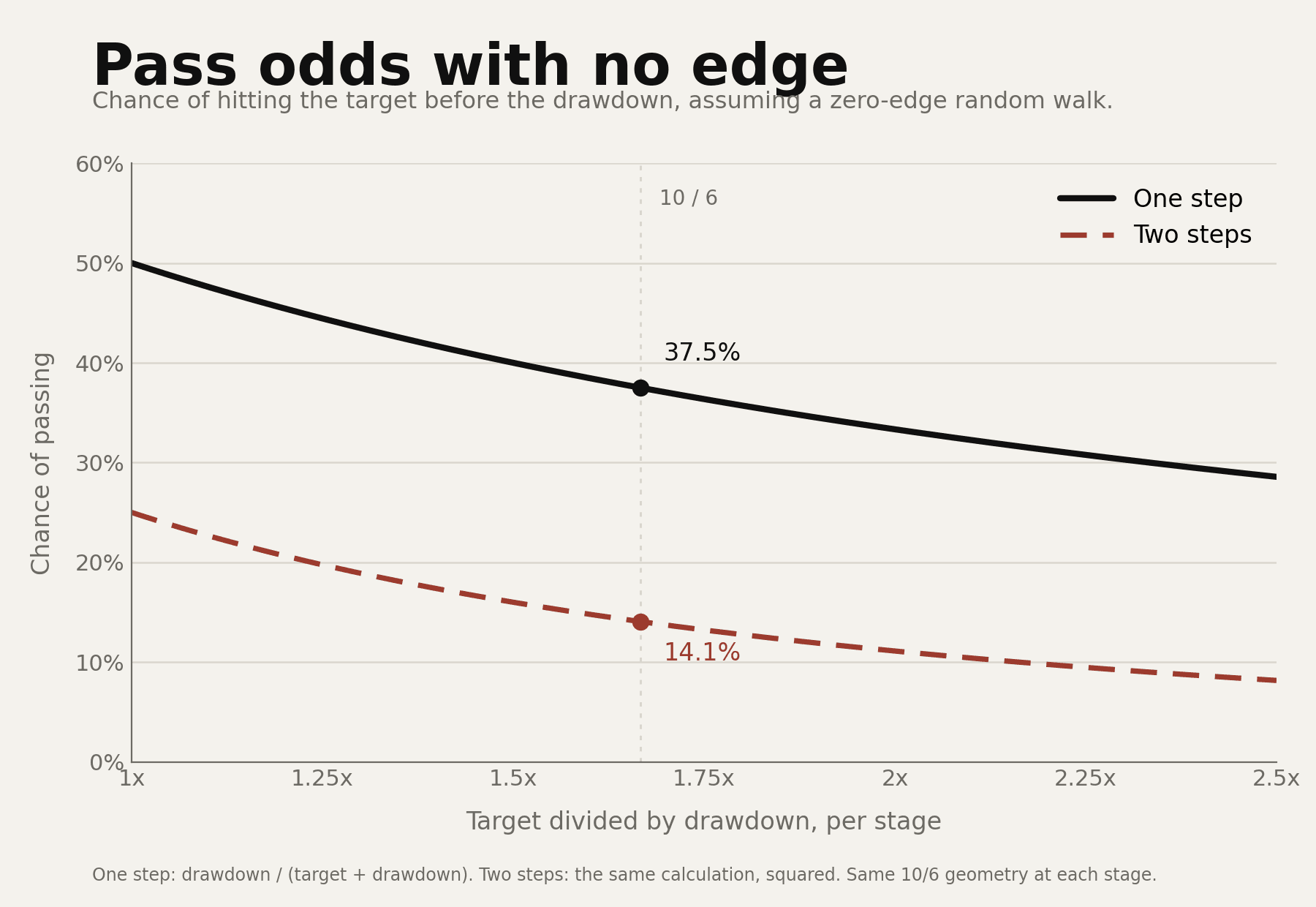
Even if you only look at the profit target and the drawdown, the geometry has a consequence that most people miss. If you have no edge at all, your chance of hitting a 10% target before a 6% drawdown is not 50/50. It is 6 / 16, or 37.5%. A two-step challenge with the same geometry at each stage passes 14.1% of the time. That is before fees, and before the funded stage. A retail strategy with negative expectancy after costs does worse than that.
That is the geometry on its own. The rest of the rulebook makes it worse.
The deadline was removed
None of the challenges have a time limit now. They used to have one, but they got rid of it because the other rules were already failing enough people. The drawdown, the daily stop and the consistency rules were doing the work.
The firm don’t need a deadline as the trader provides that. A genuine systematic edge, run at a risk level which won’t blow the drawdown, can take a very long time to get to the target and most people are simply not prepared to wait that long. So they size up. Sizing up brings the drawdown forward without in any way increasing the edge. The customer’s impatience is the clock.
A challenge with no deadline is a test of whether you’ll wait long enough for the edge to work and the industry is counting on the vast majority of people not to wait. The old deadline was a deadline; the new one is a test of whether you’ll fail on your own.
- The trade-off. A target that’s too big for the drawdown. The safe path is slow, the fast path is fatal.
- The daily stop. A limit on floating losses can kill the attempt on a bad morning before the trade has even finished.
- The consistency tax. Caps on how much of the profit can come from one day, minimum profitable days and concentration rules all cut off the big days. The big days are generally where the edge is.
- The conduct clause. One sided, abusive, gambling, not genuine. It’s all very vague in its purpose and it’s used after you’ve done well (which is when it counts).
- The small print. Allocation caps, payout delays, scaling conditions, inactivity rules, news windows. Any one of them could be changed.
None of these rules in themselves look mad and that’s the point really. Each one can be justified as risk management. Put them together and you’re effectively excluding the kind of returns that would come from a real edge. The rulebook is designed to test whether you’ll take sufficient risk to achieve the target or whether you’ll simply wait around for ever. In either case you’re going to pay for the attempt.
A real edge is small. In a liquid market a decent systematic approach might be generating a fraction of a per cent per trade and it’s only after hundreds of trades that you can begin to assess whether it’s actually working. At the risk level that will keep a 6% drawdown in check, 10% might take months or years to achieve which is a very long time to be sitting on your hands. At the risk level that will get you there quickly, a normal losing streak will take you out first. There’s no middle ground that does it both ways. That’s the trade-off.
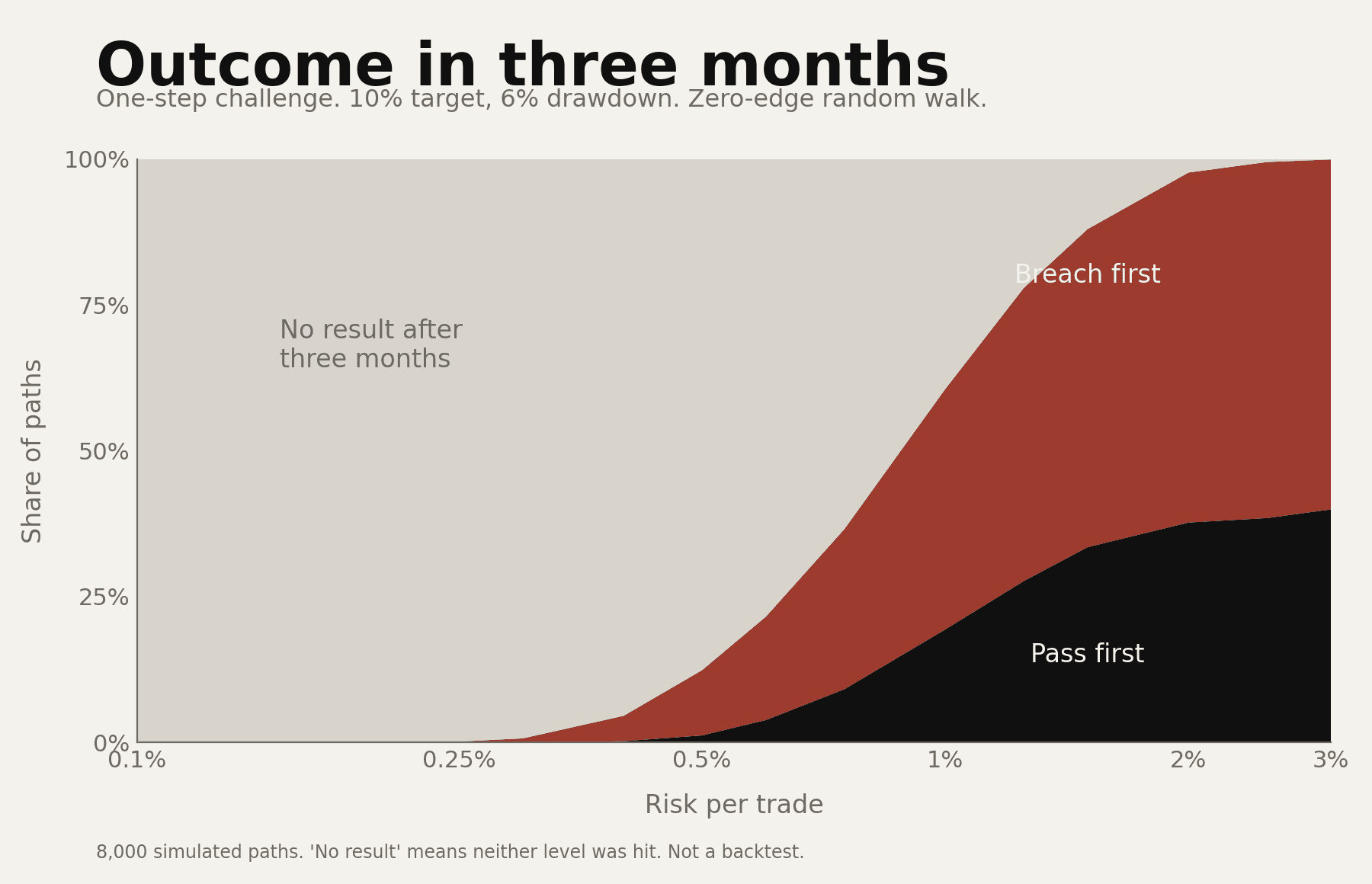
A retail trader gives a challenge a few months, not years. The chart below is a three-month window, zero edge, one step. A real retail strategy with negative expectancy does worse.
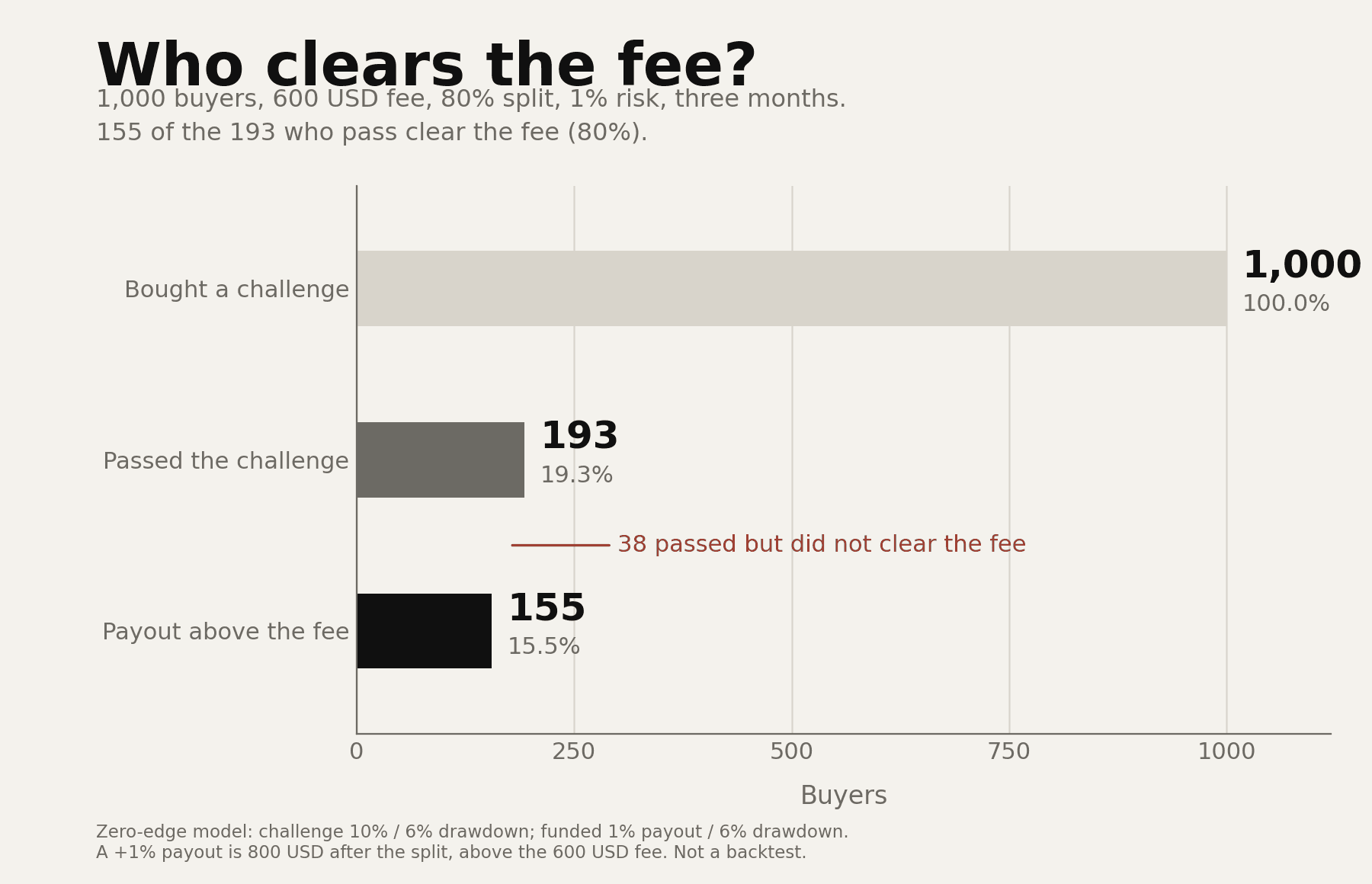
Passing is not the same as getting paid. Here is a simple version: 1,000 buyers, a $600 fee, an 80% split, 1% risk, three months, zero edge. 193 pass the challenge. 155 of them get a payout above the fee. The other 807 do not pass in that window, and 38 pass but do not clear the fee. That is 15.5% of buyers with a payout that covers the cost of the challenge. The model ignores consistency rules, payout delays and behaviour, so the real number is lower.
Leverage doesn’t fix it either. It multiplies the edge and the drawdown by the same amount so the ratio stays exactly the same. All it changes is how likely you are to blow up before you get there. At high risk, breach is more likely than pass. At low risk, you don’t get there in the time a retail trader will wait.
The daily loss limit makes it all the worse. A genuine strategy will have bad days and a daily floating loss limit can be breached on a bad morning even if the trade ultimately ends up in profit. The tighter the limit the more you have to water the strategy down and the more you water it down the further away from the target you get. The rule is there to cap risk and it’s there to cap the returns you’re allowed to have. A real edge doesn’t work like that.
Then there are the consistency rules. You can’t make a lot of profit on one day, you need a minimum number of profitable days and you can’t risk too much on any one idea. No holding through news, no risk over the weekend and you can’t go quiet for too long. Each one of those individually is perfectly reasonable, but taken together they completely kill off the big days and the big days are where the edge is. If your profit is derived from a small number of trades then a cap on the best day or a concentration rule is going to be your downfall.
The one-sided rule is the giveaway. If you’re long more often than short in a rising market, that’s what a trend edge looks like. A firm can call it ‘one sided betting’ after the event, cut your risk, withhold the payout or close the account. The rule is vague, it gets used on winners and it targets the exact thing that makes a trend or drift strategy work. It’s an exit clause dressed up as risk management.
What the audit found
I built the simulator by going through each firm’s contracts line by line, not from memory. The first version was too optimistic because it assumed the rules meant what they said. Once I read the actual terms the numbers dropped, and when I added the hidden rules they dropped again. The early results weren’t a strategy, they were rule breaches the model hadn’t charged for.
Once all the rules were in, the honest numbers were positive but very thin indeed. A lot of moving parts, fees, tax, the risk of getting banned and the return came from just a few months. It was a very stressful job with a lot of lottery attached and the rulebook was the model.
The strategies that fit the rules were the ones that were a bunch of small, short, high win rate trades. We ran them and they were either noise (no better than the fees), or just the shape of a stop and a target doing the work (that shape works on random data as well). The ones that actually survived the honest testing were the slow, directional ones which were all concentrated in one part of the day. That’s precisely the shape of the rules that they’re designed to flag.
There’s no real edge to the rulebook. That’s the entire point.
A sustainable edge has to survive costs, tax and a long enough run to be believable. Inside a prop firm, either the risk is too small to hit the target or it’s big enough that the result is a coin toss, and even a winning coin toss can be denied at payout. The prop firm means you never really own the edge.
The counterparty problem
Even if you find a shape that works you’re still at the firm’s mercy. It’s a simulated account so the firm get to decide whether they’re going to honour the number that’s on the screen. The terms give them a bit of scope: abusive, gambling, one sided, not genuine, inconsistent. Those are the terms and they can be invoked after you’ve done well which is precisely when it counts.
The payout split, the delay, the cap, the scaling plan, the allocation limit... they can all change it. You’re in a promotion and the promoter sets the terms.
So what is it?
The honest description is a trading competition with a subscription. What they’re selling is the ‘funded trader’ label, the professional identity, the six-figure account. The account is just the scoreboard and the payout is the prize. It can be a laugh, and a small number of people do make money for a while, but it’s not a way to build a trading business.
Some are genuine companies that actually pay you. The arrangement is still stacked against you though: your failure is their income and your success is their expense. It’s your belief that you’re going to make it that keeps the whole thing going. The incentives work perfectly without any need for a conspiracy.
People think the issue is that no-one gets paid, but they do. The issue is that they’re selling you simulated capital. The rules are sold as a merit test. It’s a lottery with a marketing budget and the winners are then used to sell more attempts to the people who won’t win.
One thing worth separating: this isn’t the same business as a proprietary trading desk. A real prop desk hires traders, gives them the firm’s money and takes the risk on its own book. The retail prop firm sells you a challenge, a simulated account and a payout promise. They use the same words, but they’re not the same business. This piece is about the retail challenge sellers, not the trading desks.
What I do instead
The project ended with one conclusion: own the capital. I now run my own money on Hyperliquid with no profit target, no daily loss limit imposed by anyone else and no one to approve a withdrawal. The returns are of course smaller as the leverage is lower and the risk is real, but the profit and loss is all mine. You can’t then criticise my strategy as being one sided after a good month.
I don’t even have an affiliate link for Hyperliquid so I’m not on any commission. If you want to follow what I’m up to, I’m on X as @samcleth. That’s the only plug.
We archived the project. The plan was for mass extraction and it transpired that the extraction runs the other way.